
Expats
Health Should Not Stop at the Borders
1 July 2026
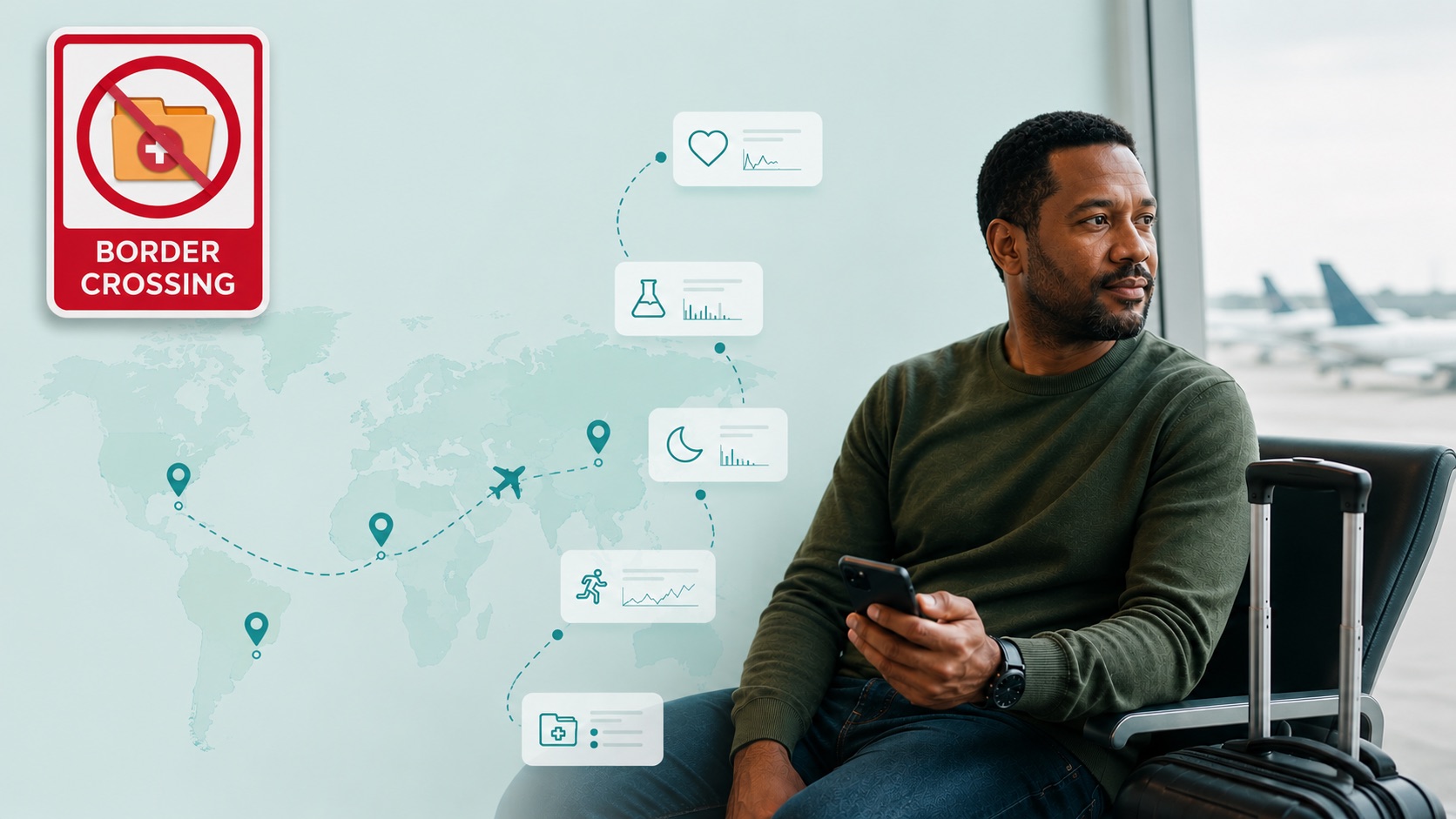
You pack up your life, sign a new lease, learn where the good bakery is, and figure out how the local health system works. Then, at your first appointment in your new country, a doctor asks a familiar set of questions: What's your blood type? Any chronic conditions? When was your last bloodwork? Do you have your vaccination history? Any recent scans?
You have all of this. It exists. Somewhere back in the country you left, there is a clean record of your cholesterol and other metrics in the last blood analysis, your blood pressure trend over the last decade, that MRI from two years ago, the allergy that nearly sent you to the emergency room. But for all practical purposes, none of it followed you across the border. So you start again — new tests, new scans, new baselines — as if you were born the day you got off the plane.
This is one of the quiet absurdities of modern life. We can move money between continents in seconds and stream the same film in forty countries, but a person's medical history often can't survive a change of address.
The strange part: the data is already the same
The frustrating thing isn't that health data is too different to travel. It's that so much of it is *identical* from one country to the next.
A complete blood count measures the same components whether it's drawn in Lisbon, Lagos, or Toronto. Hemoglobin, white cell count, platelets — same biology, same units, largely the same reference ranges. Blood pressure is millimeters of mercury everywhere. A body temperature, a resting heart rate, an HbA1c reading for diabetes, a cholesterol panel: these aren't culturally specific quantities. They are measurements of the same human body, using the same science.
Behind the scenes, a lot of the machinery is already standardized too. Lab results around the world are coded using systems like LOINC. Clinical concepts are described with shared vocabularies like SNOMED CT and ICD. When a radiologist takes a CT or an MRI, the scanner almost always produces a DICOM file — the universal format for medical imaging. A scan from a hospital in Germany opens perfectly well on a viewer in Portugal, because the standard was designed to be interoperable from the start. There's even a mature international standard, HL7 FHIR, specifically built to move health records between different systems.
So the equipment is often the same, the standards are often the same, and the measurements mean the same thing. The bottleneck isn't the science. It's the plumbing, the paperwork, and the politics.
What it actually costs
The consequences aren't abstract. They land on real people and real budgets.
For patients, it means repeating tests that were already done — sometimes days or weeks earlier — with all the cost, waiting, and occasional discomfort that involves. It means new patients arriving without a baseline, so doctors have less context and have to reconstruct a medical history from memory and guesswork. For anyone with a chronic condition, the loss of a long trend line is more than an inconvenience; a single blood pressure reading tells you far less than ten years of readings do. In the worst cases, it means a clinician making a decision in an emergency without knowing about an allergy, a past reaction, or a current medication.
For health systems, it's pure waste. Duplicated imaging ties up expensive machines and specialist time that could have gone to someone who genuinely needs a first scan. Redundant lab work consumes reagents, staff hours, and money. Multiply that across the millions of people who move between countries every year — students, workers, retirees, refugees, families — and the duplicated effort becomes enormous. And there's an environmental cost too: every unnecessary scan and test has a footprint.
None of this makes anyone healthier. It's effort spent recreating information that already existed.
Why the walls are there
To be fair, the borders around health data weren't put up out of pure bureaucratic spite. Some of the reasons are genuinely good ones.
Health data is among the most sensitive information about a person, and privacy protections exist for a reason — the last thing anyone wants is medical records leaking or being used against them. Different countries have different legal regimes governing consent and data protection, and reconciling them is genuinely hard. There are also legitimate clinical concerns: the same test can be run slightly differently from one lab to the next, reference ranges can vary by population, and a number stripped of its original context can be misread. "The patient had a value of X" is not always safe to interpret without knowing how, when, and why it was measured.
These are real problems. But notice what they are: they're arguments for doing cross-border health data *carefully*, with strong privacy safeguards and good metadata about how each measurement was taken. They are not arguments for throwing the data away and starting from zero. We solved versions of these problems for banking, for aviation, for telecommunications. Nothing about medicine makes it uniquely impossible — it's simply been lower on the priority list.
It's starting to change — slowly
The good news is that this is no longer a purely hypothetical wish. In Europe, the European Health Data Space regulation entered into force in 2025 and began applying, in stages, from March 2026. Its explicit goals include giving people access to their own health records and letting them share those records with clinicians across borders. It builds on an earlier cross-border healthcare directive and on MyHealth@EU, an existing platform that already moves patient summaries and e-prescriptions between some member states.
But the timeline is a useful dose of realism about how far there is to go. Under the current plan, priority data like patient summaries and e-prescriptions are only expected to be exchangeable across all EU countries around 2029, with imaging and lab results following around 2031. That's a decade of transition for a single (if large) bloc of countries that already share a legal framework and a single market. Outside such arrangements — for someone moving between continents rather than between neighboring EU states — there is often no mechanism at all. Your record stays behind, full stop.
What "health without borders" should mean
The goal here isn't a single global database with everyone's medical history in one place — that would be a privacy nightmare, and rightly unpopular. The goal is simpler and more human: **your health information should belong to you, and it should be able to travel with you.**
Concretely, that means a few things. You should be able to download your own complete record in a standard, machine-readable format, free of charge and without a fight. That record should be built on the international standards that, in many cases, already exist — so that a new provider's system can actually read it. There should be secure, consent-based ways to share it with a clinician in another country, with clear information about how each measurement was taken. And moving countries should trigger a transfer of your history, not its deletion.
We already accept that a passport lets a *person* cross a border. It's strange that we don't yet expect the same of the information that keeps that person alive and well. The measurements are the same. The standards are the same. Often the very machines are the same. The only thing missing is the will to let the data follow the patient.
Health shouldn't stop at the border. Neither should health data.— Saluso
Get the Saluso newsletter
Health guides and product news, about twice a month. Unsubscribe anytime.