
General
DECODING YOUR BLOOD PANEL: Understanding Fasting Glucose: What the Test Measures and How to Interpret It
8 October 2026

1. What Is Fasting Plasma Glucose and What Does It Measure?
Fasting plasma glucose (FPG) measures the concentration of glucose in your blood after an overnight fast. At this point, your body is no longer absorbing nutrients from a recent meal, so the glucose circulating in your blood mainly reflects a balance between glucose released by the liver and glucose used by the body’s tissues.
The liver maintains this glucose supply through two main processes. Glycogenolysis releases glucose by breaking down glycogen stored in the liver, while gluconeogenesis produces new glucose from substances such as lactate, glycerol, and certain amino acids. During the first 8 to 12 hours of fasting, glycogenolysis provides most of the glucose released by the liver. As fasting continues and liver glycogen stores decline, gluconeogenesis becomes the dominant source.
Insulin and glucagon help regulate this balance. During fasting, low levels of insulin help limit excessive glucose production by the liver, while glucagon supports hepatic glucose output so that circulating glucose remains available when no food is being absorbed.
This is why FPG provides a more defined view of blood glucose than a random measurement. It measures glucose under a defined fasting condition and provides information about how your body maintains glucose balance when recent food intake is no longer directly contributing to the result.
2. Why Test Preparation Matters
Fasting glucose is only meaningful when the fasting conditions are properly controlled. Fasting means having no calories for 8 to 12 hours before the blood sample is taken. The timing of the test also matters, which is why fasting glucose is typically measured in the morning.
Water is permitted during the fasting period and can help prevent dehydration from affecting the blood sample. Caloric drinks, coffee, chewing gum, and tobacco can interfere with the conditions the test is intended to measure. Nicotine and caffeine can both trigger changes in the body that may raise glucose levels.
Strenuous exercise can also affect the result. Vigorous physical activity changes how muscles use glucose and can temporarily alter the hormones involved in blood sugar regulation.
These details matter because fasting glucose is meant to measure your glucose level under a specific set of conditions. If those conditions are not met, the result may be harder to interpret accurately.
3. What a Fasting Glucose Result Can Tell You
A fasting glucose result helps show whether your body is keeping blood sugar within the expected range when you have not eaten. Results are generally interpreted as falling within a normal range, an intermediate range above normal, or the diabetes range.
The intermediate range matters because fasting glucose can be higher than normal without being high enough to fall into the diabetes range. In other words, blood sugar control during fasting is no longer fully normal, but the level has not reached the threshold used to identify diabetes. This category is called impaired fasting glucose (IFG).
One reason fasting glucose can rise is that the liver becomes less responsive to insulin. During fasting, insulin normally helps limit how much glucose the liver releases into the bloodstream. If that response becomes less effective, the liver may continue releasing more glucose than needed, causing fasting glucose to rise. This change is associated with impaired fasting glucose and can be part of the progression toward type 2 diabetes, although an elevated fasting result alone does not mean that diabetes is present.
For nonpregnant adults, the American Diabetes Association (ADA) and the World Health Organization (WHO) use different lower thresholds for impaired fasting glucose:
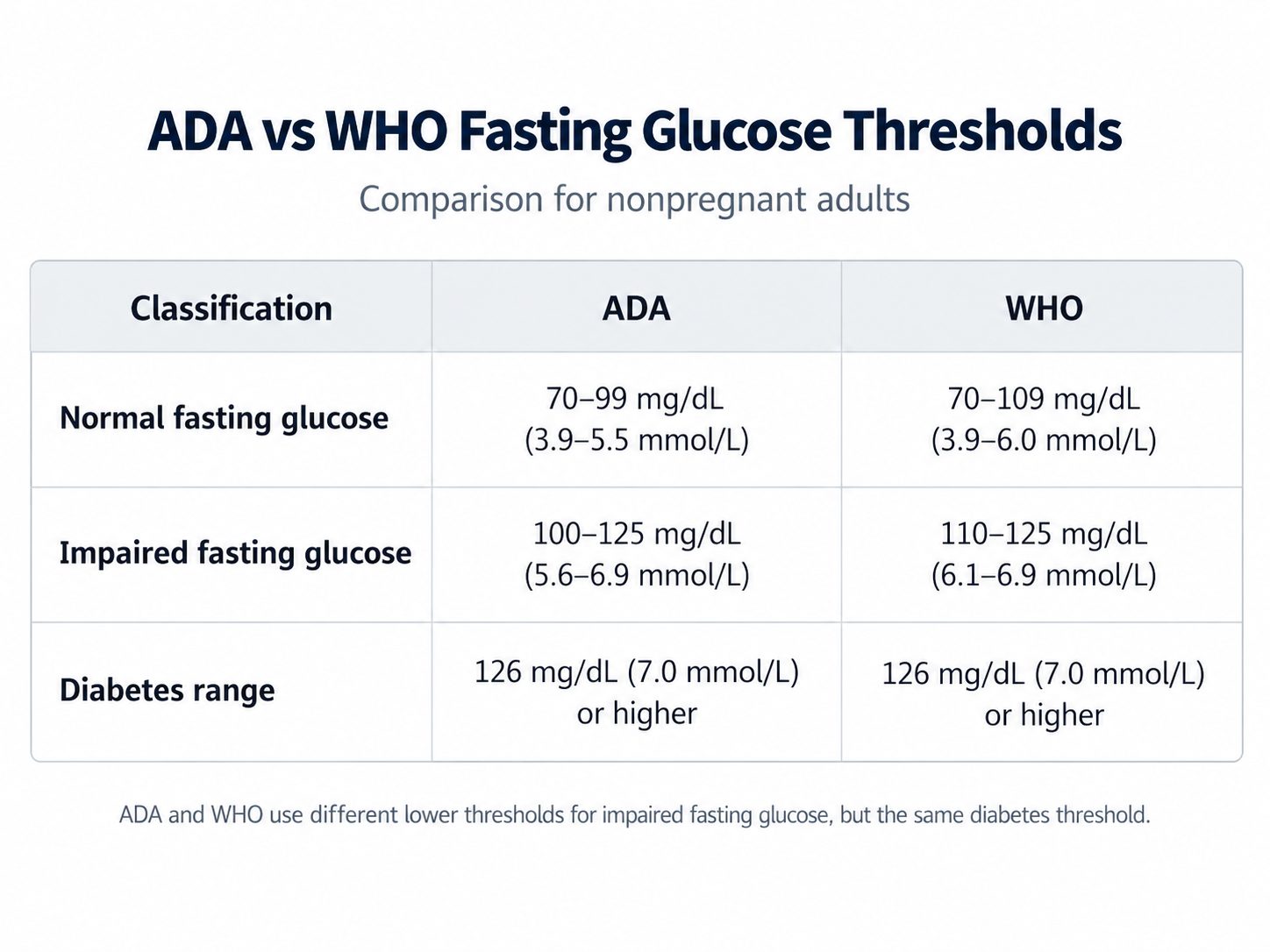
This difference is deliberate. The ADA lowered the starting point for impaired fasting glucose to 100 mg/dL to identify more people who may be at increased risk of developing diabetes and related cardiovascular disease. The WHO kept the higher 110 mg/dL threshold to use a more selective definition and reduce the risk of classifying too many people as having impaired fasting glucose.
Because of this, the same fasting glucose result can be interpreted differently depending on which guideline is being used. For example, a result of 105 mg/dL falls into the impaired fasting glucose range under ADA criteria, but remains within the normal fasting range under WHO criteria. When looking at a laboratory result, it is therefore important to consider which guideline or reference range is being used by the laboratory or clinician rather than interpreting the number in isolation.
Both organizations use the same threshold for the diabetes range: 126 mg/dL (7.0 mmol/L) or higher. A result in the diabetes range is more significant, but one high fasting glucose result does not usually confirm diabetes on its own in someone without clear symptoms of very high blood sugar. The result should be confirmed with another blood sample or with another test such as HbA1c before a diagnosis is established. Earlier in the Decoding Your Blood Panel series, we explored HbA1c in more detail in our article “HbA1c: What Your Longer-Term Blood Sugar Average Really Shows.”
4. Why Two Fasting Glucose Results Can Differ
Fasting glucose is not exactly the same every time it is measured. Even when nothing important has changed in your health, your fasting glucose can vary naturally from one day to another. Normal day-to-day biological variation within the same person is estimated at about 4.8% to 6.1%..
There is also a small amount of normal variation in the laboratory measurement itself. When natural biological variation and routine measurement variation are considered together, a modest difference between two fasting glucose results does not necessarily mean that your glucose control has genuinely worsened or improved.
For example, a change from 94 mg/dL to 104 mg/dL on two separate visits may look important because the second result crosses the ADA threshold for impaired fasting glucose. But a change of this size can still fall within the combined biological and measurement variation expected between two tests. In other words, one higher result should not automatically be interpreted as evidence that a metabolic condition has progressed.
This is one reason repeat testing can matter when a result is unexpected or falls into a diagnostic range. Looking at whether an elevated value is confirmed on another occasion helps distinguish a persistent change from normal variation between individual measurements.
5. What Else Can Raise Fasting Glucose?
Beyond the natural day-to-day variation discussed in the previous section, some specific situations can also push fasting glucose higher. These effects do not all work in the same way, and they do not necessarily reflect a lasting change in glucose regulation.
Severe physical stress can raise fasting glucose. Serious infections, major surgery, or significant physical trauma can trigger a stress response that increases blood glucose. In these situations, the higher result may reflect the body’s response to acute illness or injury rather than a persistent change in glucose regulation, and it may fall again as the underlying condition improves.
Some medications can also affect fasting glucose. Examples include systemic glucocorticoids such as steroid medications, some antipsychotic medications, certain diuretics, and calcineurin inhibitors used in transplant medicine. These medications can influence how the body produces, uses, or regulates glucose, so they may be relevant when interpreting an unexpectedly high fasting result.
Morning glucose can also be influenced by the dawn phenomenon. This refers to an early-morning rise in hormones such as growth hormone and cortisol that can push fasting glucose higher, particularly in people whose glucose regulation is already becoming less effective. This can happen even when glucose levels during the rest of the day are better controlled.
Finally, the fasting conditions themselves can affect the result. As discussed earlier, coffee with milk, caloric supplements, or a late-night snack can raise morning glucose and make a fasting result appear higher than it would under a true fasting condition.
6. When Fasting Glucose and HbA1c Do Not Agree
As mentioned previously, our Decoding Your Blood Panel series examines HbA1c in more detail in the article “HbA1c: What Your Longer-Term Blood Sugar Average Really Shows.” In that article, we explored how fasting glucose and HbA1c reflect different aspects of glucose regulation, as well as how longer-term glucose exposure and factors such as red blood cell lifespan affect HbA1c interpretation. As such, the two tests can produce different results because they capture different aspects of glucose regulation, with one result elevated while the other remains within its normal range.
For example, fasting glucose can be elevated while HbA1c remains normal. This can happen when glucose is mainly running higher in the fasting state, such as when the liver is becoming less responsive to insulin or when the dawn phenomenon raises morning glucose. If glucose levels during the rest of the day remain better controlled, the longer-term HbA1c result may remain within its normal range.
There is also another possible explanation for the same pattern. Factors that shorten the lifespan of red blood cells, such as hemolytic anemia or recent blood loss, can make HbA1c appear lower than expected. In that situation, fasting glucose may be elevated while HbA1c gives a lower reading than the glucose levels in the body would otherwise suggest.
The opposite pattern can also occur: fasting glucose may be normal while HbA1c is elevated. One reason is that glucose may rise more after meals even though the fasting level remains normal. A fasting test can miss these rises, while HbA1c can reflect their contribution over time. Factors that keep red blood cells in circulation longer can also make HbA1c appear higher than expected.
So, a disagreement between fasting glucose and HbA1c does not automatically mean that one of the tests is wrong. It can reflect the fact that the two tests are capturing different parts of glucose regulation, while other factors can also influence HbA1c independently of fasting glucose.
7. Why the Laboratory Process Matters Too
When you see a fasting glucose value on a laboratory report, that number is the result of a controlled measurement process. The way the blood sample is collected, handled, and prepared matters because each step helps the laboratory determine the glucose level as accurately as possible. In other words, the laboratory process is part of what makes the reported value meaningful.
One reason this matters is that glucose does not simply remain unchanged in a blood sample after it has been collected. Blood cells can continue using glucose while the sample is waiting to be processed. If that continues for too long, the amount of glucose measured later can be lower than the amount that was present when the blood was drawn. This is why laboratories use standardized handling and processing procedures designed to preserve the sample and reduce this effect.
The type of sample also matters. The diagnostic thresholds used for fasting glucose are based on venous plasma, which is the liquid portion of blood after the blood cells have been separated. This is not exactly the same as a whole-blood or finger-prick measurement. Home glucose meters are useful for day-to-day monitoring, but their readings are not the same type of measurement used to establish formal laboratory diagnostic thresholds.
Understanding this does not mean that you need to know the technical details of laboratory processing. The important point is that the fasting glucose value on your report is produced under defined laboratory conditions. Knowing that helps explain why the type of test and the way the sample is handled are part of interpreting the number correctly.
8. Reading Fasting Glucose in Context and Over Time
Once you have a fasting glucose result, the number becomes more useful when it is considered alongside the circumstances in which it was measured. That includes whether the fasting conditions were followed, whether anything temporary may have affected the result, where the value sits relative to the reference or diagnostic range being used, and whether related results such as HbA1c point in the same direction.
Previous fasting glucose results can add another layer of context. Because fasting glucose can vary naturally from one measurement to another, a change between two tests does not always represent a lasting change in glucose regulation. Looking at several results over time can help show whether a higher or lower value is isolated or whether a similar pattern continues across repeated measurements.
This is also why an unexpected result may sometimes lead to another measurement rather than an immediate conclusion. When a fasting glucose result falls into the diabetes range in someone without clear symptoms, confirmation with another blood sample or another test such as HbA1c is generally required. More broadly, clinical interpretation combines the laboratory result with previous findings, relevant health information, and other test results rather than relying on the fasting glucose value alone.
Keeping these results organized can make those comparisons easier. Saluso allows you to keep laboratory results together with other health information, compare results from different dates, and view changes over time through visual trends. Its AI assistant can also help analyze laboratory results in the context of your available health data and highlight changes or points that may deserve attention. This can help you keep track of your results and prepare for a more informed discussion with a healthcare professional, rather than using an individual fasting glucose result in isolation. This support is intended to help you understand and organize your health information, not to replace medical advice or a healthcare professional’s assessment.
Get the Saluso newsletter
Health guides and product news, about twice a month. Unsubscribe anytime.